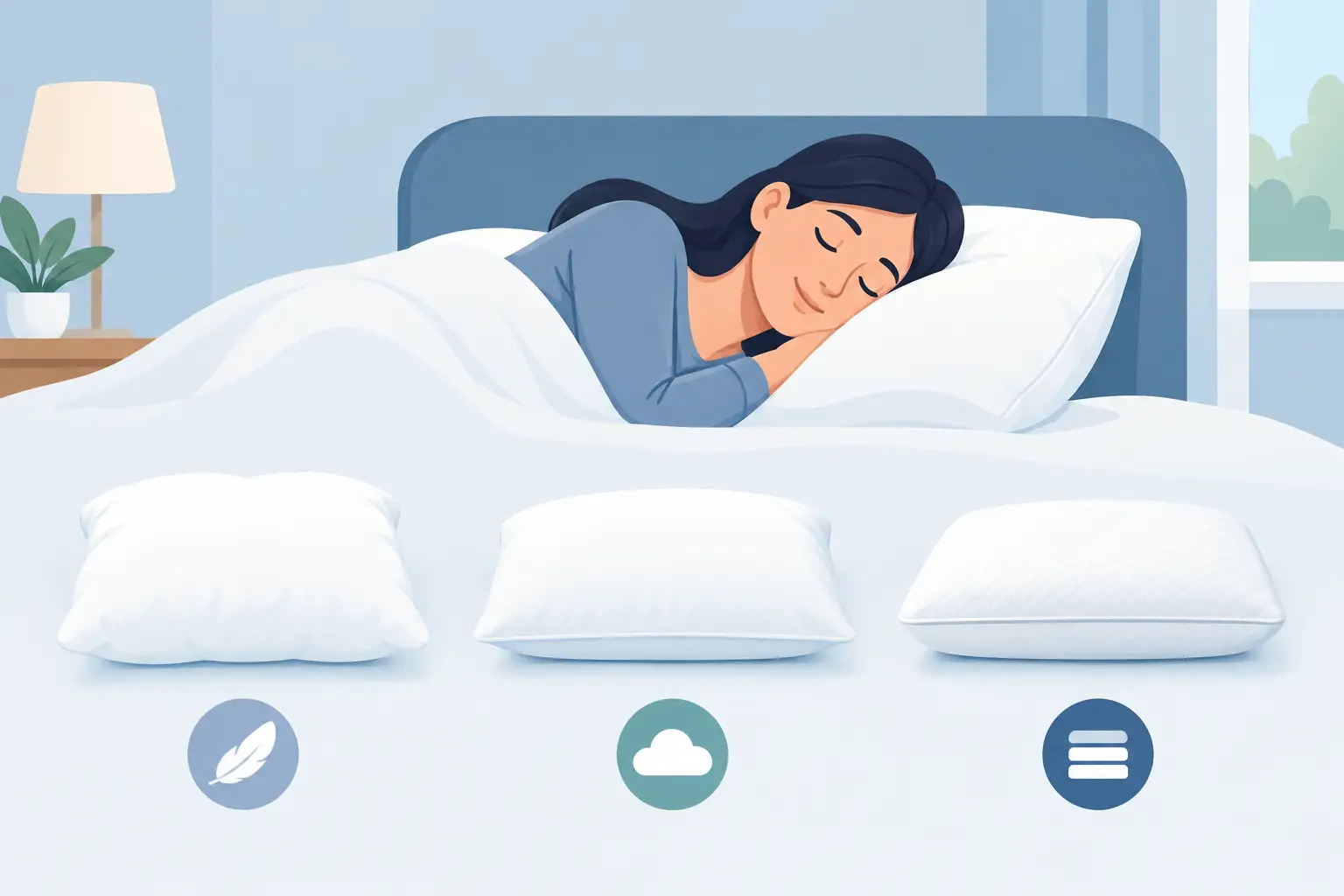
Which pillow firmness feels best is not just a matter of preference. The wrong pillow can leave your neck bent too high, too low, or at an awkward angle for hours. That can mean waking up with a stiff neck, sore shoulders, or the familiar urge to fold your pillow in half before morning.
The practical goal is simple: choose a pillow that keeps your head, neck, and spine in a more neutral line while you sleep. Firmness matters, but it works together with pillow height, often called loft, and the material inside the pillow. A firm pillow that is too tall can be just as uncomfortable as a soft pillow that collapses flat.
Which Pillow Firmness Fits Your Sleep Position?
Your usual sleep position is the best place to start. Think about the position you are in when you first wake up, not only the position you use when falling asleep. Most people settle into a pattern overnight, and that pattern should guide the purchase.
Side sleepers usually need medium-firm to firm support
Side sleeping creates the largest gap between the mattress and your head because your shoulder sits between them. A medium-firm or firm pillow helps fill that space and keeps your head from dropping toward the mattress.
Look for a medium to high loft, depending on shoulder width and mattress softness. Broad-shouldered sleepers often need more height, while someone on a plush mattress may sink in enough to need a slightly lower pillow. The pillow should support your head without pushing it upward toward the ceiling.
A dense fiber-fill pillow, firm down alternative pillow, or supportive foam style can work well here. The trade-off is that very firm materials may feel less moldable. If you like to tuck an arm beneath the pillow or shape it around your face, medium-firm may be the better balance.
Back sleepers often do best with medium firmness
Back sleepers usually need a pillow that supports the curve of the neck without lifting the head too far forward. Medium firmness is often the most reliable choice because it provides structure while allowing a little give.
Choose a low to medium loft. When lying on your back, your chin should not be pressed toward your chest. If it is, the pillow is likely too tall, too firm, or both. If your head tips noticeably backward, the pillow may be too thin or too soft.
Many back sleepers like hotel-style pillows because they can feel cushioned without going completely flat right away. A pair can also be useful: use one pillow under your head and keep another available for extra support when reading or relaxing in bed.
Stomach sleepers usually need soft, low pillows
Stomach sleeping naturally turns the head to one side, which can put strain on the neck. A soft pillow with a low loft helps limit how far the head is lifted from the mattress. Some stomach sleepers are most comfortable with a very thin pillow or no head pillow at all.
A firm, high pillow is usually the least suitable option for this position. It can force the neck into a sharper angle and make morning stiffness more likely. If you sleep partly on your stomach and partly on your side, try a soft-to-medium pillow with a lower profile rather than a thick firm pillow.
Combination sleepers need a compromise
If you change positions often, do not buy based on one position alone. A medium-firm pillow with medium loft is generally the safest middle ground. It should have enough support for time spent on your side but enough cushioning for back sleeping.
Combination sleepers may also prefer a pillow with resilient fill. A pillow that regains its shape after you shift positions is more useful than one that stays compressed in one spot. It may take a few nights to adjust, especially if your old pillow was worn down.
Firmness and Loft Are Not the Same Thing
It is easy to confuse a pillow's firmness with its height. Firmness describes how much the fill resists pressure. Loft describes how high the pillow holds your head above the mattress. Both affect comfort.
For example, a soft pillow can be high when it is new but compress quickly under the weight of your head. A firm pillow can be low-profile yet still provide steady support. That is why a label such as “firm” is helpful, but it does not tell the whole story.
Before choosing, consider your mattress as well. A firmer mattress keeps your body closer to the surface, so you may need a pillow with more loft. A softer mattress lets your shoulder and upper body sink farther down, often reducing the pillow height needed. Your body size also matters: a larger frame or wider shoulders may require more space-filling support than a smaller frame.
Choose Fill Based on the Feel You Want
Pillow fill affects firmness, shape, breathability, and price. There is no single best fill for every household, but knowing the basic differences makes comparison faster.
Polyester fiber fill and down alternative fills are common choices for everyday pillows. They are generally lightweight, familiar in feel, and available across soft, medium, and firm options. They work well for shoppers who want practical comfort and easy replacement without paying premium specialty-material prices.
Memory foam offers more contouring and tends to feel more structured. It can be useful for sleepers who want a pillow to hold its shape, but some people find it warmer or less adjustable. Shredded foam is usually more moldable than a solid foam block, although the feel varies by construction.
Down and feather fills can feel soft and compressible, but they may require fluffing to maintain loft. They are not always the best choice for someone who needs strong, consistent support through the night. Latex is springy and durable, though it often feels firmer and comes at a higher price point.
For a simple guest-room setup, medium pillows are often the most flexible choice. They suit a wide range of sleepers better than an extremely soft or extremely firm option. Adding a mix of medium and firm pillows can also make a bed more accommodating without overcomplicating the purchase.
Signs Your Current Pillow Is the Wrong Firmness
Your pillow does not have to look completely flat to be past its useful life. Pay attention to how you feel when you wake up and how the pillow behaves under your head.
A pillow may be too soft if you wake with neck tension, find yourself stacking pillows, or notice your head sinking until it is nearly level with the mattress. It may be too firm or too high if you wake with shoulder pressure, headaches, or a chin that feels pushed toward your chest.
Other practical signs include clumping fill, permanent dents, uneven support, lingering odors after washing, or a pillow that needs constant reshaping to be usable. Washing can freshen many pillows when the care label allows it, but it cannot restore fill that has lost its ability to support you.
A Simple Way to Test Pillow Support at Home
When you lie down in your normal position, ask someone to look at the line from the center of your head through your neck and upper back. For side sleeping, your head should stay fairly level rather than tilting down or up. For back sleeping, your head should rest comfortably without the neck being forced forward.
You can also notice whether you feel pressure after five to ten minutes. A good pillow should not require constant adjusting. It will not solve every sleep issue, but it should make settling in easier rather than becoming the problem you keep correcting.
If you are replacing several household pillows, consider choosing by use instead of buying identical firmness for every bed. A medium-firm option is practical for most primary sleepers, soft low-profile pillows can serve stomach sleepers, and firmer pillows can support side sleepers or provide extra sitting-up comfort. Keeping a small, useful mix is often more cost-effective than replacing everything with a one-size-fits-all choice.
At The Sale Central, value-minded shopping does not have to mean guessing. Start with your sleep position, match the loft to your mattress and body frame, and select a firmness that supports your neck without making the bed feel overbuilt. The right pillow is the one you stop thinking about once the lights are out.